The Majestic African Buffalo
Discover the Untamed Beauty of Africa's Iconic Giant
With its intimidating stature and commanding presence, the African buffalo leaves an indelible impression on anyone who meets it.
When we look at some interesting African buffalo facts about this dangerous African animal, we will discover why they are also known by hunters as "Black Death".
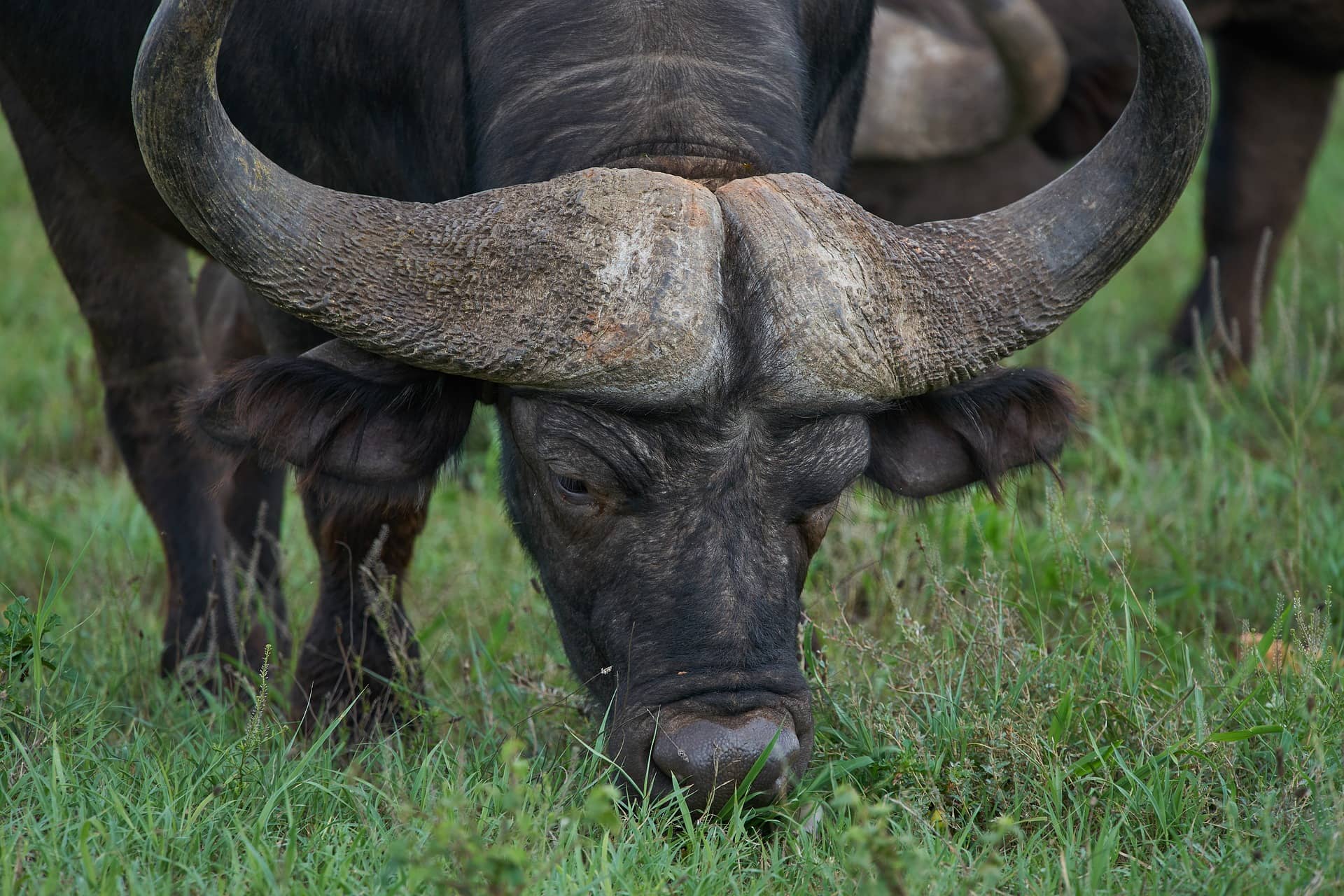 African buffalo syncerus caffer
The base of Cape buffalo horns comes so close together that they fuse. This creates a shield on their heads known as a “boss”.
Female buffalo horns do not have a “boss”.
The larger and thicker the horns of adult buffalo males belong to higher-ranked individuals.
Cape buffalo danger facts
Why is Cape Buffalo is so feared by hunters that know them as ambush hunters? Some call them "the Black Death" or "the widow maker."
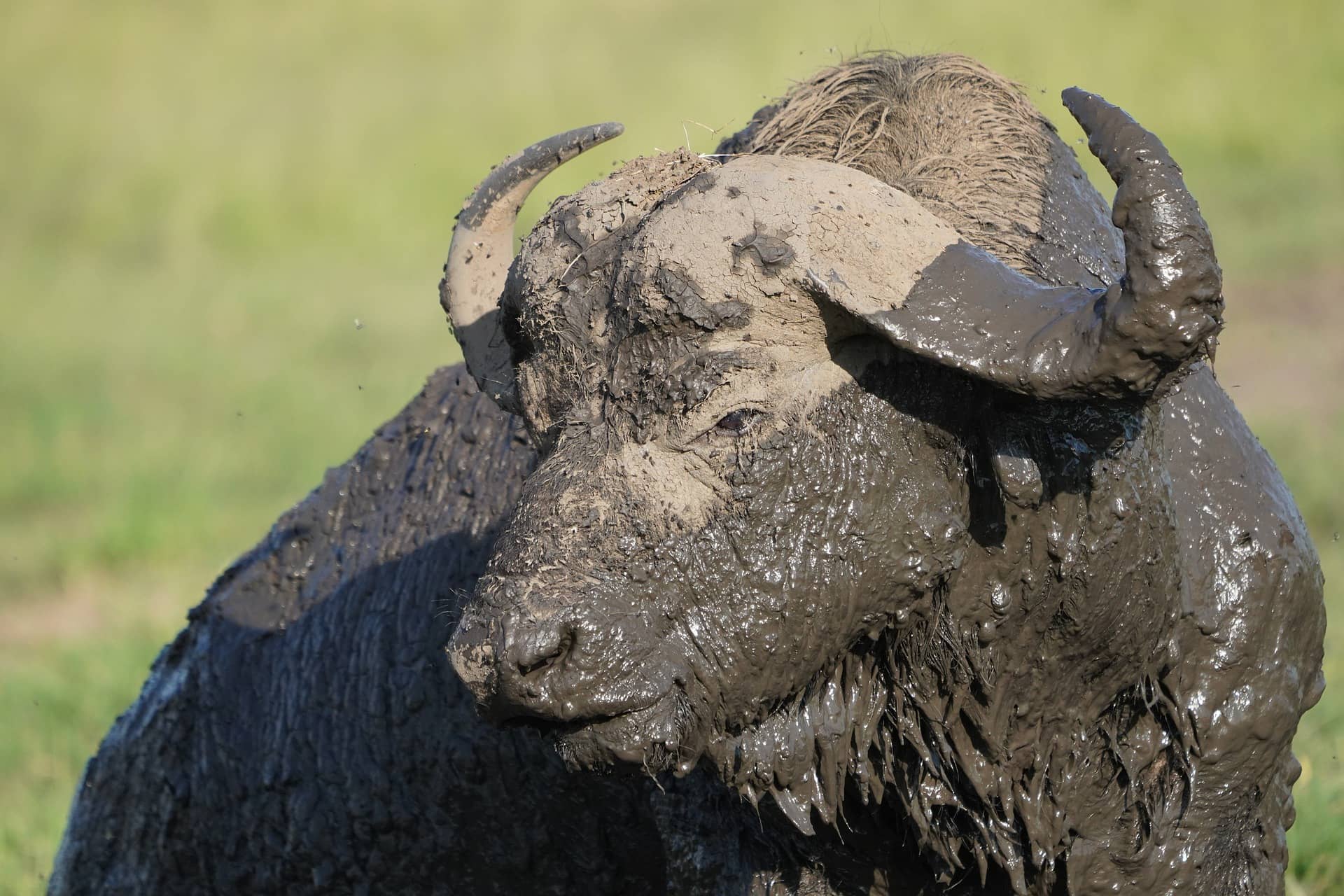 Their imposing stature and ferocious horns make them a sight to behold.
African buffaloes are known to kill more hunters in Africa than any
other wildlife animal.
Many stories are told about how they ambush hunters that have wounded them during hunting expeditions.
How to recognize Buffalos
They are part of the Big Five animals in Africa, together with the lion, leopard, rhinoceros, and elephant.
Adult males are black or charcoal gray, while females have a slight tinge color.
The hair is short and coarse.
They have large heads and thick necks on their massive bodies with short limbs.
The horns grow from the thick bosses on the forehead.
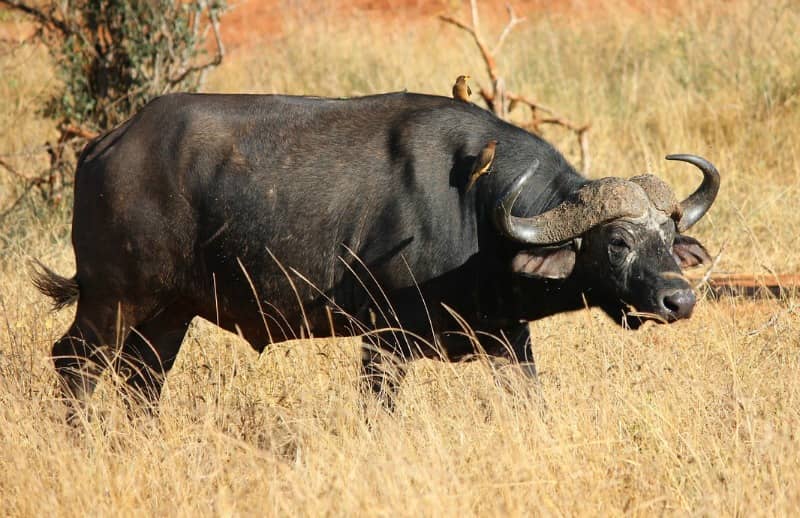 Grumpy and unpredictable African buffalo.
The horns flare sideways and downwards and then curve upwards to the tip.
Cape buffalos are dimorphic, which means that the male and female look identical.
Male Cape buffalos get larger than adult females, and they differ in size and weight, as you can see from the table below:
|
African buffalo size |
Males |
Females |
|
Length |
3,2 meters |
3 meters |
|
Height (at the shoulder) |
1,45 meters |
1,4 meters |
|
Weight |
625 kilograms |
530 kilograms |
|
Scientific name |
Syncerus caffer | |
|
Conservation status* |
Listed as least concern by the IUCN |
*The Cape buffalo is a sought-after trophy animal by hunters with large bulls being the main target.
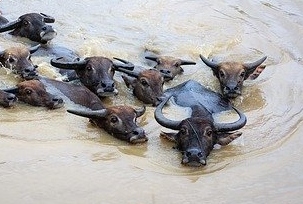
African buffalo vs Water buffalo
They are not closely related to each other.
African buffalo |
Water buffalo |
|
Distribution on African Continent - no water buffalo on the African continent |
Found in Asian countries |
|
Size - see table above |
Water buffalo weighs more than 700 kg to 1200kg. Also, longer at 2.4m and 2.7m in length. Up to 1.9 m in height. |
 |
 |
Wild |
Domesticated |
|
Aggressive nature makes them impossible to domesticated, extremely unpredictable, and temperamental. considered an extremely dangerous animal. |
Fully domesticated as a source of social status, as a form of transportation and plowing. |
What is the preferred habitat of buffaloes?
These African animals prefer open and wooded savannas with suitable grass cover.
They seek out good grazing in the early morning and late afternoon hours.
They need water every day.
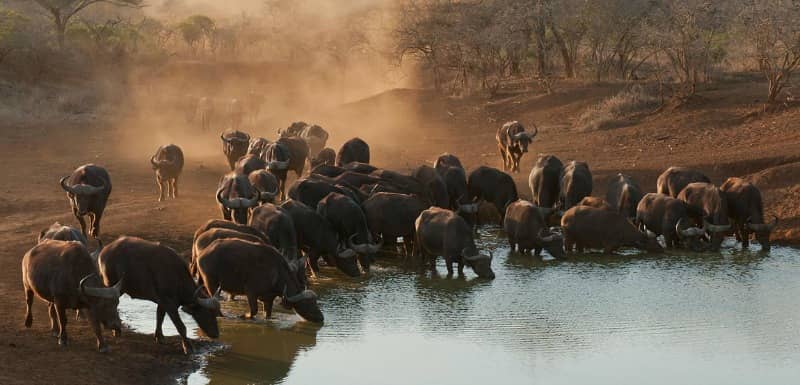
These members of the tribe Bovine are best seen during the African summer, when grazing is rich.
These days, breeding herds are usually a few thousand strong.
As the African sun starts burning towards noon, they disappear into thick cover to rest.
They are not exceedingly difficult to spot because their movements are fairly predictable.
You may notice the adult male will wallow in mud as protection against biting flies and to keep cool.
What do African buffalos eat?
The Syncerus caffers are grazers but they will browse shrubs and forbs if the grass is unavailable.
They prefer leaves to stems because the leaves are more nutritious.
They do most of their grazing at night, in the early morning and evening so that they can escape the heat of the day by standing or lying in shade.
These large bovines drink up to forty liters twice a day; after the morning feed and before the evening one.
To obtain minerals and trace elements lick termite mounds and the mud stuck to their companions.
How do buffalos breed?
The bulls detect when a cow is on heat by regular sniffing of her genitals and urine.
During the three days that she is on heat a female is getting the attention of bulls that court her by laying their chins on her rump.
It takes a buffalo bull at least eight years to fight his way high enough up the dominance hierarchy to secure opportunities to mate.
Old males beat off other males by virtue of their greater size and long combat experience.
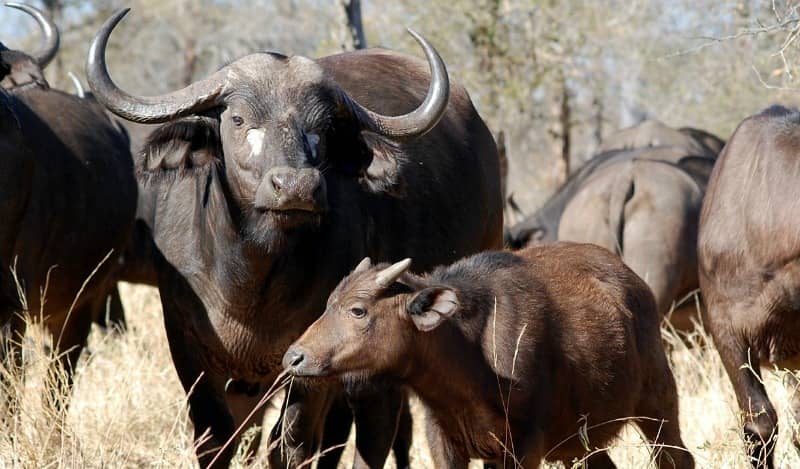
A female remains with the herd when she gives birth.
The calves are not extremely fast runners, and they sometimes get left behind with their mothers if the herd bolts.
The calf suckles for about 15 months.
Social Ties remain strong between female calves and their mothers.
Male calves disperse into the main herd.
Are African buffaloes territorial?
The herds have home ranges that do not overlap with those of neighboring herds but are seldom defended as territories.
The home ranges of old bulls may be as little as three to four square kilometers.
Herds use known routes.
Herds are led between their water and grazing areas by bulls or cows in the upper half of the dominance hierarchy.
How is dominance established in a large herd?
The pecking order is established when the bulls start with several ritualized threats.
You can observe that the intention to confront is signaled by a head-high pose with its nose pointing downward and its shoulders hunched.
If the If a bull wants to emphasize its size, it may stand sideways to its opponent.
A submissive buffalo will hold its head low and horizontal so that its Horns are back.
If the two animals are remarkably close together the submissive bull will put its nose under the belly of its superior.
More intense threat displays involve head-tossing, short chases, horn hooking, and soil gouging.
What are the privileges of a high social ranking in buffalo circles?
High rank provides the privilege of traveling and feeding in front of the center of the herd.
Why would this be important?
This means obtaining the best grazing and, in addition, maximum protection from predators.
The low-ranking animals at the back must graze what the herd leaves behind and suffer most heavily from predation.
Is the Cape buffalo a dangerous animal?
The reason early trophy hunters included the African buffalo as one of the big five is that they were one of the most dangerous species to hunt.
When hunted by humans, buffalo have a reputation for circling back on their pursuers and counterattacking.
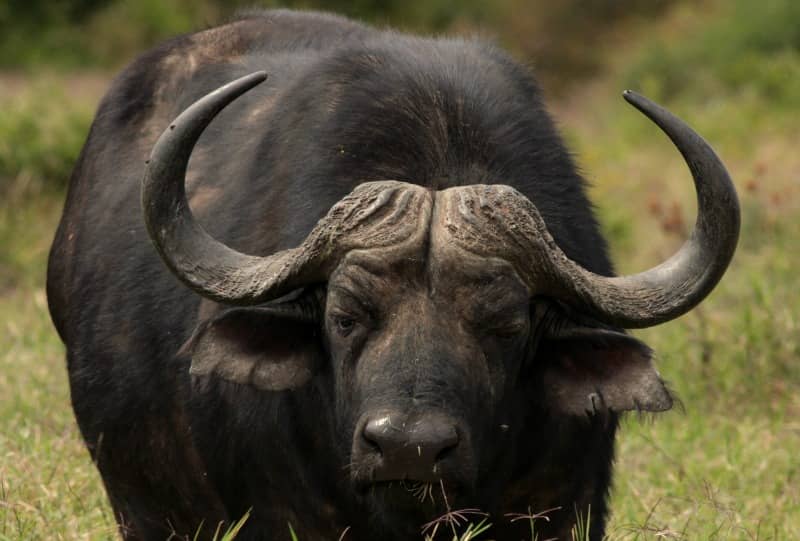
The danger lies with older males, who usually live away from the herd.
Their "attack is the best defense" strategy can make them extremely dangerous
Old males tend to wander alone or to form small groups of up to about half a dozen and are more easily provoked into an attack.
The reason for this relates to the fact that they lack the safety in numbers of the bigger herds.
Buffalo in herds are placid, although some of the old bulls in the herds tend to be easily angered and prone to charge when disturbed.
Large herds are usually very relaxed and unlikely to attack.
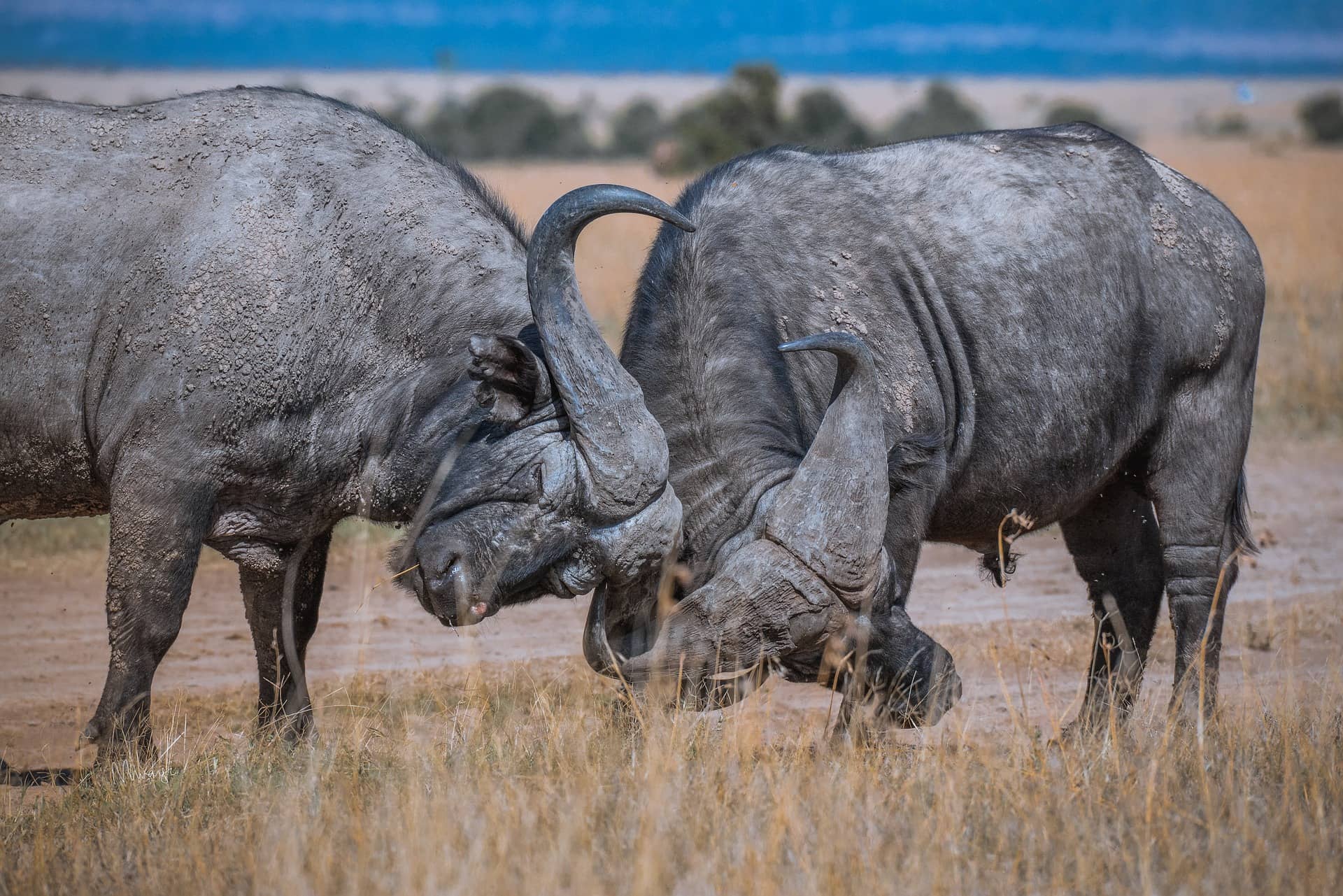
Occasionally a full-scale fight is necessary.
At this time, the combatants will charge each other with their heads up and at the last moment lower their heads for a bone-crunching crash.
The weaker bull will be pushed sideways and immediately breaks and runs to avoid a horn in the flank.
When two 800-kg African buffalo bulls charge each other head-on the impact is equivalent to a car hitting a wall at 50 km/h.
It is thus not very surprising that nearly all fights are usually finished after the first full-scale charge.
Buffalo are very gregarious and live in large herds, containing up to a few thousand animals of both sexes and all ages.
Some of the young bull's form bachelor groups.
The largest herds are seen during the dry season.
Old males tend to wander solitary or to form small groups of up to about half a dozen.
Who are their most important predators?
Lions are their most important predators, but spotted hyenas also take them as food.
In the Savuti buffalo are 41% of lion kills in the dry season.
How do African buffalo defend themselves from predators?
Lions will wait near water that buffalo must have every day.
Female lions do most of the hunting. They will decide on an attack tactic depending on the number, size, and strength of the buffalo herd they plan to attack.
They will sometimes wait near the water for buffalo to approach. The lions will try to break the buffalo's neck.
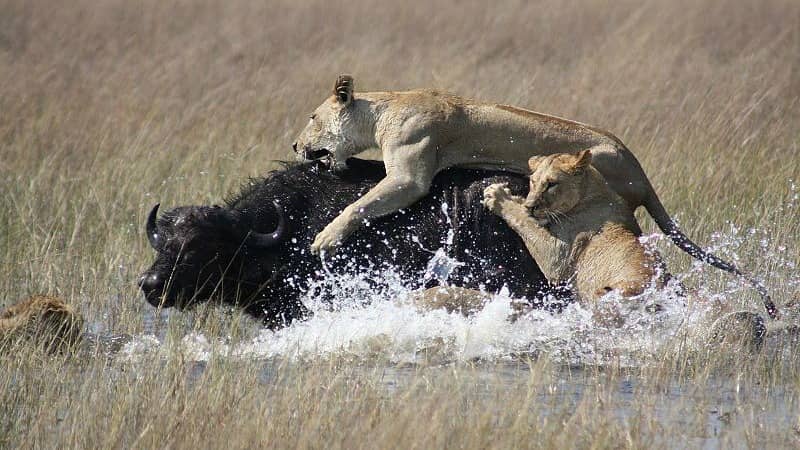
Obviously, the animals on the fringe of a herd are more vigilant than those in the middle.
When panicked, a whole herd will stampede, to the peril of any predator in its path.
A herd is very protective of its members.
Distress bleats of calves will bring the entire herd to the rescue.
Lions have been observed being chased up trees by buffaloes.
Conclusion
The African buffalo, often known as the Cape buffalo, is a magnificent sight to witness, standing over six feet tall and weighing up to a ton.
It roams the African grasslands and forests in vast herds, producing an incredible display of nature's might.
The buffalo, with its unique curving horns and stocky physique, emanates strength and toughness; it is really a force to be reckoned with.
Like this page?
Wildlife home
 |
Wildlife conservation
 |