The Story of Nature's Toughest Beast
the Adorable and Fearless Honey Badger
Welcome to the brave and intriguing world of honey badgers, where these small creatures show that size does not define power.
Join us as we discover the secrets of the honey badger's survival skills and capacity to thrive in the face of tough competition.
The honey badger navigates the ever-changing environment confidently, leaving its competitors in awe of its keen instincts and agility.
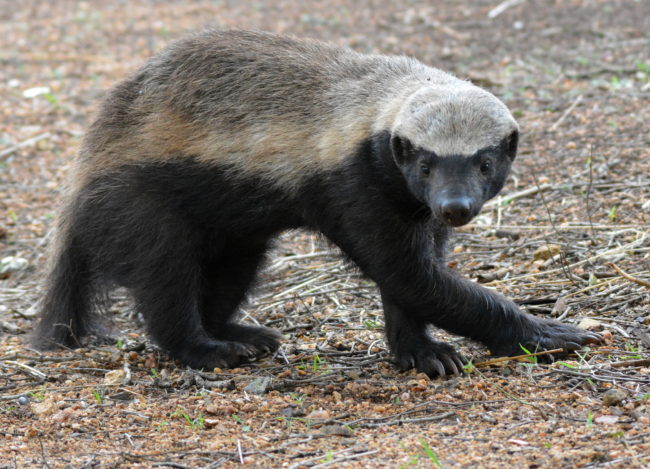 Image from SANBI
The honey badger comes with a well-deserved reputation. This animal is known as "the world's most fearless creature."
This prestigious title has been earned because of this animal's tenacity.
This little creature will munch honey from the African ‘killer bee’ hives and not think twice about eating venomous snakes. They have also been seen taking on a pride of lions.
So, have you ever wondered about the honey badger in folklore and popular culture?
In this post, we will delve into the wonderful world of honey badgers, including their interesting qualities, hunting skills, and extraordinary tenacity. Prepare to be amazed by the fierce fighters of the animal kingdom—honey badgers—and discover:
- How are honey badgers so tough?
- Are they really fearless?
- Do they eat honey?
- What habitat do they prefer?
- Are they endangered?
How do honey badgers manage to be so tough?
These wildlife animals are well equipped to live up to their fearsome reputation.
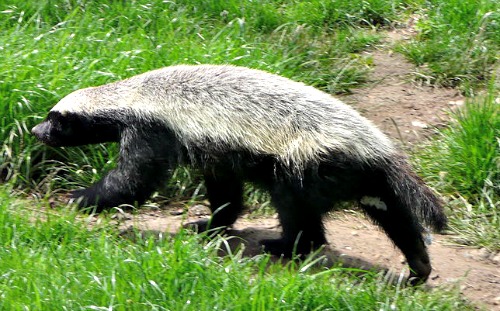
There are accounts that they have killed a blue wildebeest, a waterbuck, and a 3-meter python.
It attacks fearlessly when threatened and has also put-up savage resistance against a lion.
The antelope victims bled to death after having the scrotum torn off.
It is thus no wonder that much larger predators usually give them a wide berth.
Honey badgers don't care.
Honey badgers (Mellivora capensis) prey on and survive bites from venomous snakes and stinging bee attacks.
Many people get reminded about the fierce and fearless honey badger via a comical YouTube video that has become famous.
This tells the story of how honey badgers “don't care” about standing up to vicious predators when getting their food. The video contains footage of a National Geographic documentary of a badger winning a fight with a king cobra.
It is stocky and compact in build and in addition to this it has a thick skull, a strong neck, and shoulders.
Their coat is also very loose resulting in their ability to turn around and bite back with powerful jaws and fight back with their claws.
Honey badgers are also known as "ratels"
Their distinctive black and white pattern is undoubtedly a warning to other animals to stay clear.
Under threat, a ratel gives a high-pitched growl.
When they are under extreme duress may release a foul-smelling secretion from their anal glands.
Are honey badgers immune to snake venom?
Among the few animals known to be resistant to venomous snake bites, the honey badger (Mellivora capensis) has an almost mythical capacity to attack and withstand the toxic bites of snakes with venom.
The bite of a king cobra can cause the death of a healthy human adult within fifteen minutes. Honey badgers have been observed to survive bites from various venomous snakes.
A quarter of their diet consists of these animals.
Do they eat honey?
Yes, it is well known that they have a fondness for honey and are notorious for raiding beehives.
When the ratel finds the hive, it plunders it while emitting smelly, suffocating secretions from their anal glands to fumigate the hive.
This causes most of the bees to flee while it scoops out the honeycomb.
When the badger leaves, the bird eats the remaining dead bees and pieces of honeycomb.
The thick skin of this animal may offer protection from bee stings.
They are however not impervious to them, and bee stings may in fact account for some of their deaths.
Is it true that they cooperate with Hone guide birds to find honey?
The stories are that the Greater honey guide bird guides them to the beehives by calling them and repeatedly fanning its tail, displaying the white outer feathers.
The bird then swoops from tree to tree and waits for the animal to follow it to the bee's nest.
The honey badger will answer the bird with a grunting and growling sound.
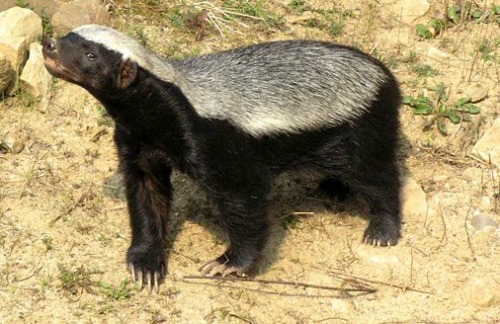
This African animal is however a very nocturnal animal and doubt exists about how reliable a partner the Greater honeyguide bird would make as a diurnal animal.
This issue is still contentious and despite the
many cited stories remains to be undocumented.
Where are honey badgers found?
They are active at any time of the day and night, but they become nocturnal where there is human disturbance.
They can tolerate both very wet and very dry habitats.
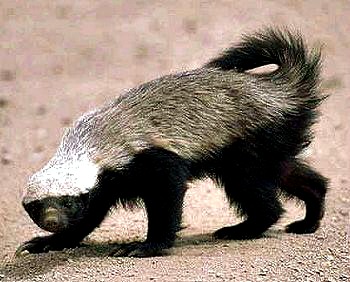
You can expect to see them in moist
savanna, semi-desert, and forest areas.
They are always solitary although sometimes pairs can be
seen together.
When they move slowly, sniffing for prey with its nose close to the ground.
They liberally apply scent markings to crevices, holes, and the base of trees while they move.
They sleep in rock crevices or in holes in the ground that they dig themselves or take over from other animals.
What do honey badgers eat?
They are reported to regularly consume frogs, lizards, turtles, rodents, snakes, and birds.
In addition, badgers regularly consume snakes, frogs, and turtles.
In fact, honey badgers have evolved to consume dangerous snakes. They have been observed killing and eating cobras, rock pythons, and even black mambas (the world's most venomous snake).
Can honey badgers climb trees?
The honey badger is a master the art of digging and climbing trees. Ratels are also good swimmers.
They will also climb into trees to get at birds' nests and bees' honey.
This little African animal is extremely strong, and it uses the long, sharp claws of their front feet to dig rodents, scorpions, and baboon spiders out of the ground.
They often tear apart tree logs to get at the insect larvae and beetles inside.
Other small predators, like black-backed jackals, may shadow a honey badger, hoping to grab prey that may escape the badger.
What other mammals will they eat?
In terms of small mammals their intake consists of 30% mice.
Scorpions and spiders make up 14%, lizards 18% and snakes 18% of their mammal intake.
Most of its prey is dug out of burrows.
Are honey badgers endangered?
Because they raid honey, they do face increasingly hostile challenges from beekeepers.
Beekeepers are not prepared to lose substantial amounts of their honey to the badgers.
The result is that they are increasingly poisoned, trapped and shot.
They also suffer indirect persecution through indiscriminate poisoning and trapping for jackals and caracals.
Conclusion
The honey badger is one of the most tenacious, fearless, and survival-savvy animals in the wild.
Honey badgers, with their muscular bulk, thick skin, and razor-sharp claws, are deadly predators capable of taking down animals much larger than themselves. Their dogged pursuit of prey, combined with their fearlessness, has given them a reputation as one of the fiercest fighters in the animal kingdom.
Honey badgers have also received attention for their distinctive defensive strategies. From their capacity to tolerate snake bites to their courageous encounters with lions and other predators, these creatures have repeatedly demonstrated that they should not be underestimated.
Like this page?
Wildlife home
 |
Wildlife conservation
 |